How do I know if my narrative is working?
Four signals, none of them traffic. The strongest one is whether people describe you accurately to someone else after one conversation.
How do I explain a product nobody has seen before?
Anchor to what they do today, then name what changes. If you don't pick the comparison, buyers pick one, and it is usually unflattering.
In a two-sided marketplace, which side should the narrative start with?
The side that is harder to get, which is usually supply but not always. How to tell, and why chicken-and-egg is often a clarity problem.
How do I message a two-sided marketplace?
Write a promise per side, then check whether both can be true at once. The contradiction most marketplaces publish without noticing.
How do I tell my founder story without making it about me?
Make the buyer the hero and yourself the guide. A grammar test that shows you which one your story currently has, plus three fixes.
Should the founder story be in the pitch deck?
Yes, as evidence rather than biography. Investors are asking why this team, which is narrower than tell me about your journey.
Where does the founder story go on a website?
About page in full, footer in one line, homepage almost never. Where each version goes and why the homepage is the wrong place.
What makes a founder story worth telling?
One where what you went through is the reason you can solve their problem. Three ingredients, and the three kinds that never land.
How much of my personal story belongs in my marketing?
Only the part that proves you understand the buyer's problem. Everything else is memoir. The test that tells you which details to cut.
How do I keep my message consistent across print, social, and my website?
Match the message to how targeted the channel is. Print has no doors. Social is one room pretending to be several. Email is the only real exception.
Do I need different messaging for referral partners?
Yes, and it is usually the most neglected audience you have. They are deciding whether recommending you makes them look good, not whether to buy.
What if my audiences want opposite things?
First find out whether the conflict is real or apparent. One is a messaging problem. The other is a positioning decision no wording will solve.
Why do my team members describe the business differently?
Because you never wrote it down, so each of them built their own version by inference. The two-minute diagnostic that proves it.
What comes first, the narrative or the website?
The narrative. A website is a narrative rendered in pages, and building the container first is how founders end up rebuilding within a year.
What do investors want that customers don't care about?
Market size, growth rate, defensibility, pedigree. Customers care about none of it, and care about four things most decks never mention.
How do I talk about traction to customers?
Translate it into their risk, not your growth. Three examples of the same fact framed for each audience, plus what to say when you have almost none.
How do nonprofits talk to donors and the people they serve at the same time?
Write the thread around the shared outcome, not around need. The people you serve read the same page your donors do, and they can tell the difference.
Should each audience get its own landing page?
Yes if they make a different decision. No if they just have a different title. The two-line test, plus why non-buyers sometimes deserve a page most.
How do I write a website for multiple audiences?
One shared claim on the homepage, a separate page per audience underneath. Going broad lands on nobody. Going separate creates contradictions.
Should I announce my funding round on my website?
Findable, yes. In the hero, rarely. A raise reads as momentum to some buyers and as burn risk to others, and you do not choose which.
Should my website speak to investors or customers?
Customers, almost always. Investors read your site as evidence rather than as a pitch, and a sharp buyer-facing page helps you in both rooms.
Can I use the same pitch deck for investors and customers?
No, and the reason is structural. The two decks are ordered differently because they argue differently. What carries over and what does not.
What is the difference between a founder narrative and a founder story?
A founder story is your personal origin: why you started. A founder narrative is broader. It connects that why to what you sell and to what your buyer needs, so it works in every channel instead of just your About page.
What is a founder narrative strategy?
It is the throughline that keeps your story the same everywhere buyers meet you. It is not a one-time origin story. It is the system that decides what you say on your website, in a pitch, and in outreach, so you are not reinventing the message every time.
Do I need to niche down to get clients?
You don't have to serve only one type of client. But your marketing has to lead with one. Here's the difference.
How much should I charge for consulting?
There is no magic number. Price the outcome, not the hour, and set a floor you never go below. Here is how.
Can I use this for my team?
Yes. That's one of the biggest benefits. When the narrative is locked, every team member pitches the same way, uses the same language, and sends the same quality of assets.
How is this different from hiring a copywriter?
A copywriter writes words. This builds the strategy underneath the words. Without a locked narrative, a copywriter is guessing what to say. With a locked narrative, everything converts because the foundation is solid.
Is this just for new businesses?
No. The narrative framework works at every stage. Early-stage founders use it to build their first pitch. Growth-stage founders use it to unify their messaging across team members and channels.
What if I already have messaging that kind of works?
"Kind of works" is the most expensive place to be. You're closing some deals but leaving most on the table. CoBuilder doesn't replace what's working. It locks it down so it works every time, everywhere.
How do I raise my coaching rates?
Yes, but the approach matters. Raising rates without changing the offer is a negotiation.
Should I specialize as a fractional executive?
You should specialize your marketing, not your capability. Pick one type of company and one type of problem to lead your...
What should a fractional engagement look like?
A fractional engagement should look like a packaged outcome with a defined scope, timeline, and deliverable set.
What if a coaching prospect wants a free trial session?
Offer a paid diagnostic session instead. A free trial invites comparison. A paid session invites commitment.
How many fractional clients can I handle at once?
Two to four, depending on the engagement scope. A fractional executive typically allocates one to two days per week per...
How do I find my first fractional client?
You find your first fractional client the same way you find any first client: by activating your existing network with a...
Can I sell coaching without picking a niche?
You can sell without choosing a permanent niche. But you can't sell without choosing a specific person to talk to.
How do I create a coaching offer clients buy on the first call?
Your offer is probably too vague for a first-call close. Name the person, the outcome, and the timeline.
I have certifications but still struggle to sell. What's wrong?
Certifications prove you're qualified. Offers get you booked. Lead with the result, not the credential.
I'm a coach. Why can't I get clients consistently?
You don't need more leads. You need a clearer offer. When buyers can't tell what you do, they don't buy.
How do I build a fractional executive practice?
The work isn't the hard part. The positioning is. Go from 'fractional CFO' to a specific offer for a specific buyer.
I left corporate and want to go independent. Where do I start?
Start with the CoBuilder trial. It turns your corporate expertise into a clear, sellable offer in 15 minutes.
How long does Launch Pad take and what do I walk away with?
Three months. Eight finished artifacts. You walk away with a complete go-to-market system. $6,500.
What happens during an Ignition Sprint?
One 90-minute session. Walk out with a story pitch and a one-pager. $1,500. Assets, not advice.
How do I know when my pitch is ready?
When someone who's never heard of your business can repeat it back accurately after hearing it once.
Can I have different pitches for different audiences?
Yes, but they should all share the same core offer. The pitch adapts. The promise stays the same.
My website describes what I do but nobody contacts me. Why?
Your website probably describes your services, not the buyer's problem. Visitors leave when they can't see themselves in your message.
What if I can help multiple types of clients?
You probably can. But trying to sell to all of them at once makes your offer invisible to each of them.
How do I price my expertise without competing on hourly rate?
Price the outcome, not the hours. When you sell a result, the buyer stops comparing you to cheaper options.
What should I say when someone asks 'so what do you do?'
Lead with the outcome: 'I help [who] [achieve what] so they can [bigger benefit].' One sentence.
How do I simplify my message without dumbing it down?
Simplifying your message isn't dumbing it down. It's translating expert knowledge into buyer language.
How do I know if my offer is confusing buyers?
If prospects say 'that's interesting' and disappear, your offer isn't clear enough for them to act on.
I just left corporate. Where do I start?
Start with your offer. Not your website, not your business cards, not your LinkedIn. Your offer.
What's the difference between a service and an offer?
A service is what you do. An offer is what the buyer gets, framed as a specific outcome for a specific person.
What does offer clarity actually mean?
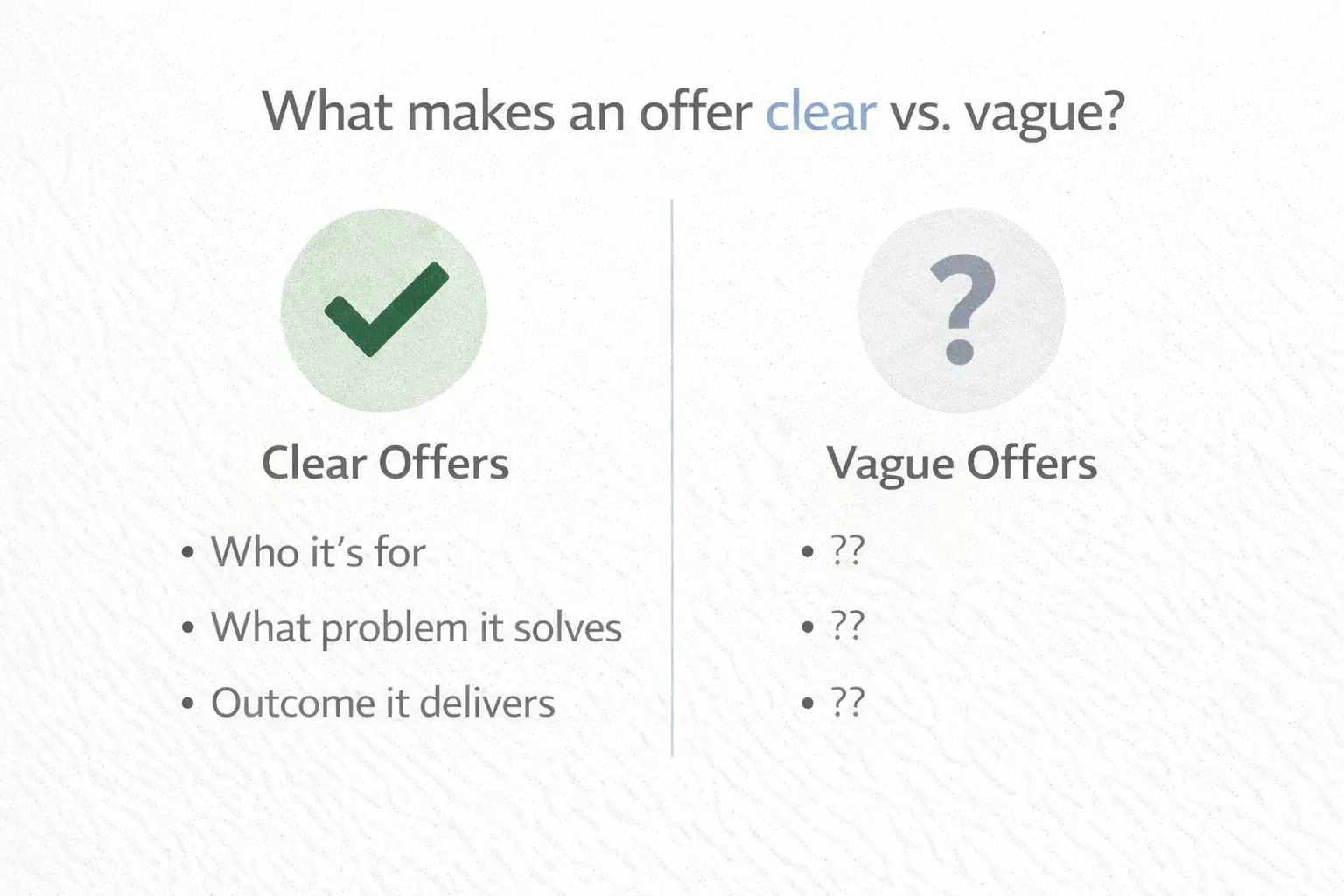
It means a buyer can understand what you sell, who it's for, and why it matters in one sentence.
How is this different from a startup accelerator?
Accelerators are built for cohorts and optimized for the next raise. We build your specific assets and take no equity. When each one is the right call.
I have co-founders. Can we do this together?
Yes. In fact, the biggest value for co-founder teams is alignment. When the offer statement is locked, everyone pitches the same way. No more 'my co-founder says one thing, I say another.' Start with the free trial and run through it together.
We're a technical product. Will this work for something complex?
The more complex the product, the more you need a simple offer. CoBuilder doesn't simplify what you do. It translates what you do into what the buyer cares about. The technology is the proof. The offer is the promise.
I'm pre-revenue. Is it too early for this?
Pre-revenue is the best time to lock your offer. Most startups waste their first 6-12 months with a fuzzy message, burning through runway on outreach and ads that don't convert. The free trial takes 15 minutes and gives you an offer statement, pitch script, and one-pager you can test this week.
I've been burned by courses and programs before. How is this different?
Courses teach you frameworks and leave you to figure out execution. We build the assets with you. Your offer statement, your outreach scripts, your sales emails. Finished artifacts, not homework. And the free trial proves it before you spend a dollar.
What if I'm not sure what I want to offer yet?
That's exactly the right time to start. The free trial walks you through a diagnostic that identifies your growth stage and surfaces the clearest path forward. You don't need to have it figured out before you start.
I've already tried writing my offer. Why would this be different?
Because you're too close to your own work. You know 47 things you can do. CoBuilder helps you pick the one that matters most and frame it as an outcome the buyer cares about. An outside perspective fixes in 15 minutes what you've been stuck on for months.
I just left corporate. Is this too early for me?
Pre-revenue is actually the best time to get your offer clear. The CoBuilder free trial was built for exactly this stage. Most corporate escapees build their first usable assets in one session and upgrade to Core or Ignition within 30 days.
Why does my pitch change every time I explain it?
Because you never wrote it down, so you compose it live every time. The four things that should never change, and the recording test that finds them.
How do I know if I’m targeting the wrong audience?
Five signs you're pitching the wrong people, plus the one question that tells you in a single conversation whether this prospect was ever going to buy.
What should I say when someone asks, “So what do you do?”
Your job title isn't an answer. Here's the one-sentence structure that makes people ask a follow-up question instead of just nodding.
How do I clearly explain my offer in one sentence?
One audience, one problem, one outcome. If your sentence needs a qualifier, it isn't finished. The two tests that tell you when it is.