
How do I know if my offer is confusing customers?
If prospects hesitate, ask for explanations, or struggle to repeat what you do, your offer is confusing. Confusion doesn’t create objections... it creates silence.
Offer Clarity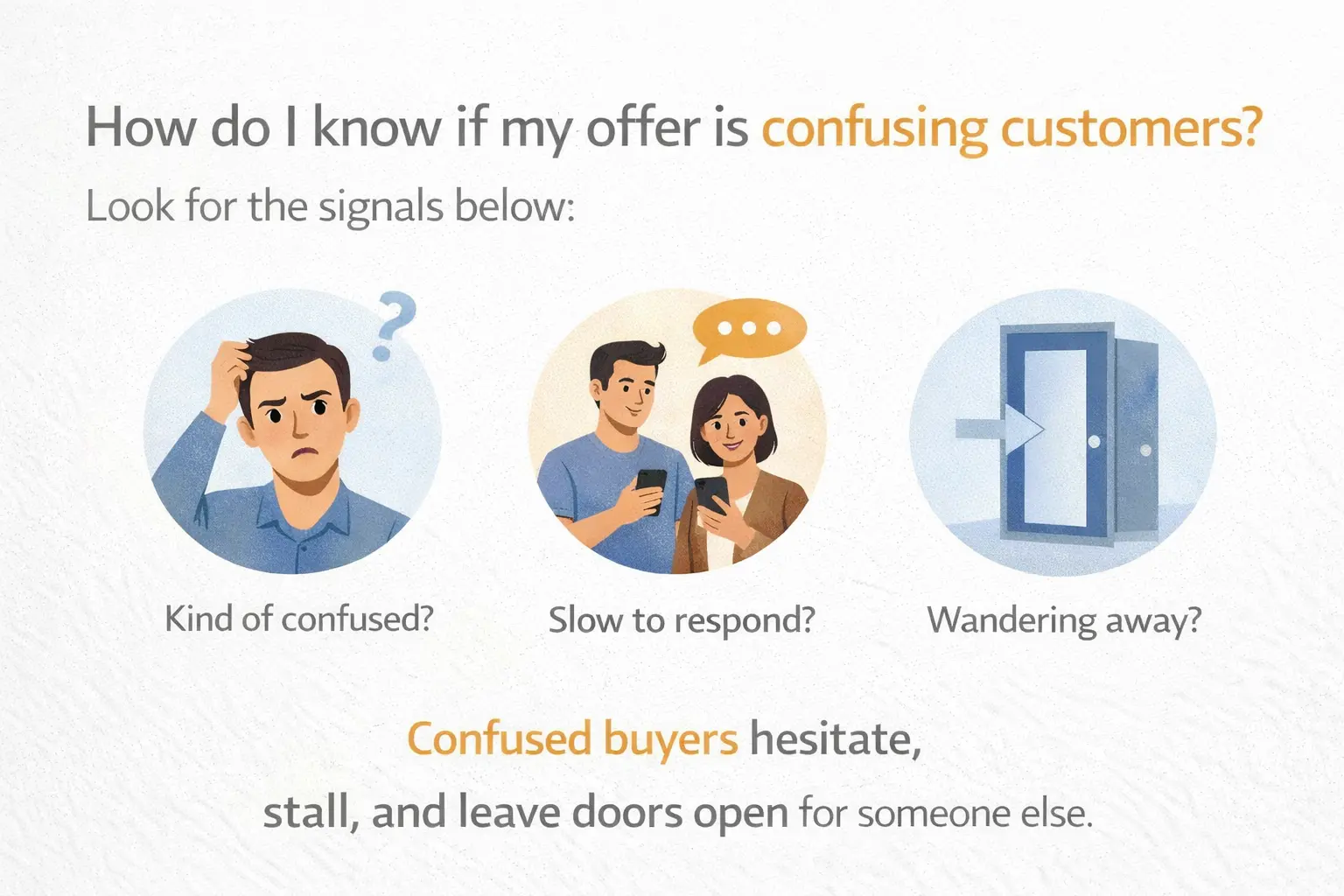
If prospects hesitate, ask for explanations, or struggle to repeat what you do, your offer is confusing. Confusion doesn’t create objections... it creates silence.
Offer ClarityMost customers will never tell you your offer is confusing.
They won’t say, “I don’t understand what you do.”
They won’t argue with you.
They won’t push back.
They’ll just pause.
They’ll say they need to think about it.
And then they’ll disappear.
This is what makes offer confusion so dangerous. It doesn’t show up as rejection. It shows up as inertia.
Founders often misdiagnose this problem. They assume:
Sometimes those things are true. But far more often, the real issue is that the buyer couldn’t clearly answer one simple question in their own head:
“What exactly am I getting—and why does it matter?”
Here are a few clear signals your offer is confusing customers:
1. Prospects ask you to explain it multiple times
If every sales call starts with clarification, your offer is doing too much work in conversation. A clear offer should do most of the heavy lifting before you speak.
2. People respond with interest, but not action
Comments like “That sounds interesting” or “That makes sense” feel positive—but they’re neutral. Interest without movement is often confusion dressed up as politeness.
3. Sales cycles drag without a clear reason
When buyers understand value, decisions speed up. When they don’t, everything slows down.
4. Your offer changes depending on who you’re talking to
If you find yourself reshaping the offer for every conversation, it’s a sign the core promise isn’t anchored yet.
Confusing offers usually suffer from one of three problems:
Founders often avoid tightening their offer because clarity feels restrictive. It can feel like you’re closing doors or limiting future options.
But the opposite is true.
Clarity doesn’t reduce opportunity.
It creates momentum.
A clear offer makes decisions easier. It lowers mental effort for the buyer. It allows the right people to self-select and move forward with confidence.
And here’s the most important reframe:
Confusion doesn’t create objections.
It prevents decisions altogether.
When you fix clarity, you’ll notice:
If your offer requires explanation to feel valuable, it’s not finished yet. And that’s not a failure—it’s simply the next layer of work.
The Launch Pad Sprint produces 12 finished artifacts, from Narrative Map to Landing Page, plus 60 days of coaching. $6,500.
Learn About Launch Pad