
What does offer clarity actually mean?
Offer clarity means your buyer instantly understands who it’s for, what it solves, and what changes if it works. No decoding. No explaining. No guessing.
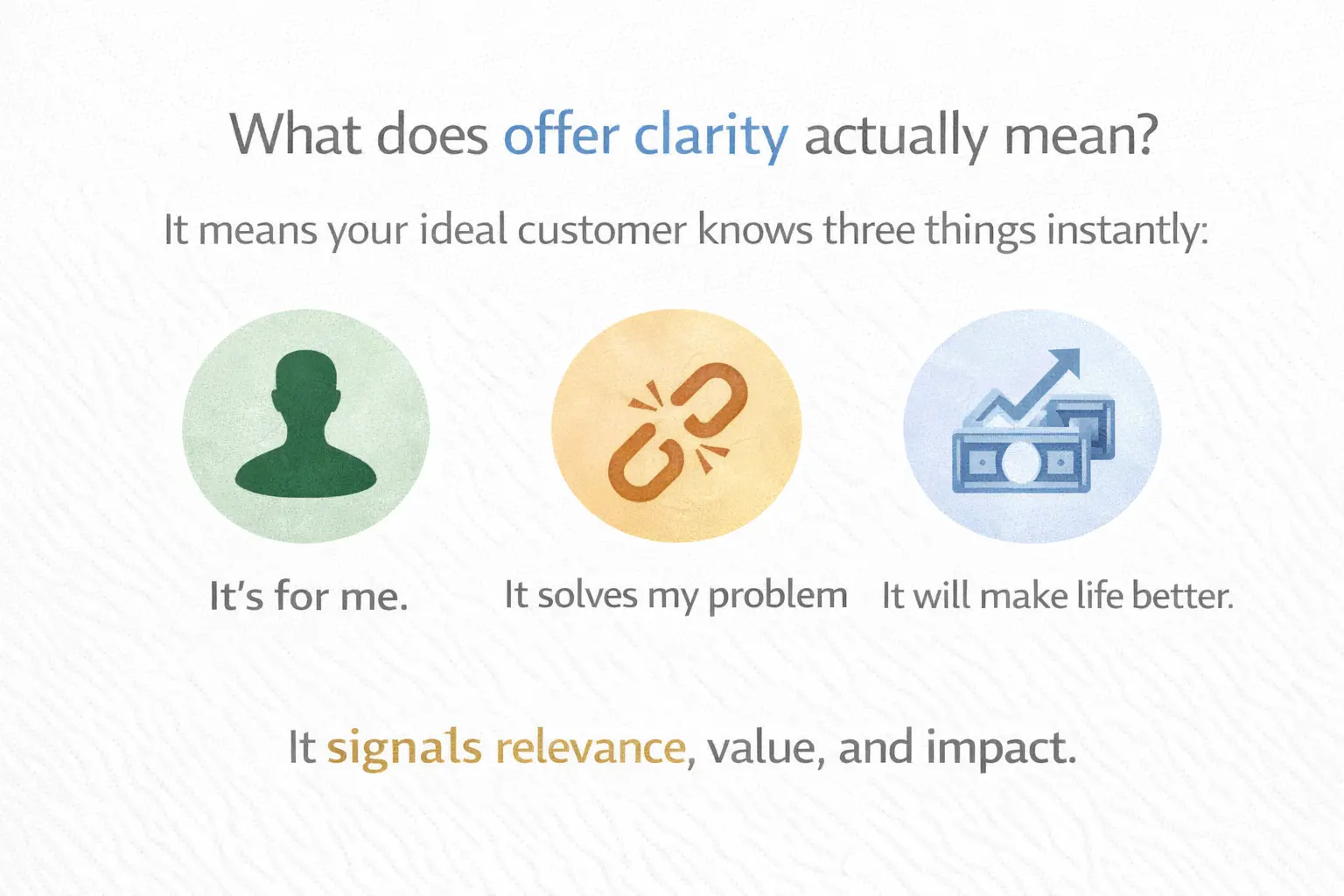
Offer clarity means your buyer instantly understands who it’s for, what it solves, and what changes if it works. No decoding. No explaining. No guessing.

Offer clarity is one of those phrases founders hear all the time, but rarely get defined.
It’s not branding.
It’s not copy.
It’s not simplification for its own sake.
Offer clarity is decision clarity.
A clear offer removes mental effort for the buyer. It answers their internal questions before they have to ask them out loud.
When clarity is missing, buyers wonder:
If those questions linger, momentum dies.
Clarity lives at the intersection of three things:
Miss one, and the offer weakens.
Many founders confuse clarity with detail. They add more explanations, more features, more examples. But clarity usually comes from subtraction, not addition.
What can be removed?
What can be decided?
What can be named clearly instead of vaguely?
Clear offers don’t promise everything. They promise something real.
This is also why clarity feels uncomfortable. It forces you to choose.
And choosing means saying no to other interpretations.
But buyers trust commitment.
When your offer is clear:
Clarity isn’t about locking yourself in forever.
It’s about making it easy to move forward now.
Many founders sell services when they think they’re selling offers.
A service is open-ended.
An offer is intentional.
Services focus on inputs:
Offers focus on outcomes:
When you sell services, buyers struggle to understand value. Pricing feels arbitrary. Scope creeps. Confidence drops.
When you sell an offer, the buyer knows what success looks like.
Offers create leverage. They make sales repeatable and delivery cleaner.
This shift from service to offer is one of the most important transitions a founder makes.
It’s also where many businesses get stuck.
Clarity here changes everything:
Founders often resist simplicity because they equate it with losing credibility.
They worry:
But buyers don’t reward complexity. They reward clarity.
Sophisticated businesses communicate simply because they understand what matters most.
Simplicity is about sequence, not reduction.
You can explain complexity, but only after someone understands why they should care.
Lead with:
Then go deeper if needed.
Clear messages respect the buyer’s time and attention. They don’t force people to work to understand value.
If your message only makes sense after explanation, it’s not ready yet.
If your pitch changes depending on who you’re talking to, you’re not alone.
This happens when founders are still searching for resonance instead of leading with clarity.
Each conversation becomes a test:
The result? Inconsistency... and internal doubt.
Changing your pitch doesn’t mean you’re bad at messaging. It means the foundation underneath it isn’t stable yet.
When the core promise is clear, delivery becomes flexible, but the message stays the same.
Founders often confuse adaptability with clarity. But adaptability without a core creates drift.
A stable pitch gives you:
When your pitch is locked:
Clarity creates confidence because you know what you’re offering and who it’s for.
Offer clarity is one of those phrases founders hear all the time, but rarely get defined.
It’s not branding.
It’s not copy.
It’s not simplification for its own sake.
Offer clarity is decision clarity.
A clear offer removes mental effort for the buyer. It answers their internal questions before they have to ask them out loud.
When clarity is missing, buyers wonder:
If those questions linger, momentum dies.
Clarity lives at the intersection of three things:
Miss one, and the offer weakens.
Many founders confuse clarity with detail. They add more explanations, more features, more examples. But clarity usually comes from subtraction, not addition.
What can be removed?
What can be decided?
What can be named clearly instead of vaguely?
Clear offers don’t promise everything. They promise something real.
This is also why clarity feels uncomfortable. It forces you to choose.
And choosing means saying no to other interpretations.
But buyers trust commitment.
When your offer is clear:
Clarity isn’t about locking yourself in forever.
It’s about making it easy to move forward now.
Most founders don’t realize they’re targeting the wrong audience because they’re still getting some interest.
People reply.
Calls get booked.
Conversations happen.
But nothing converts cleanly.
Targeting the wrong audience rarely looks like zero traction. It looks like constant friction.
Here are some common signals:
These aren’t sales problems. They’re audience fit problems.
The wrong audience doesn’t mean bad people or unqualified leads. It means you’re talking to people who don’t feel the pain strongly enough—or don’t have the context to value the outcome.
Right audiences don’t need convincing.
They need clarity.
Another common mistake is defining your audience by surface traits instead of buying behavior.
“Founders.”
“Coaches.”
“Small businesses.”
Those labels are too broad to guide decisions.
What matters more is:
If your audience isn’t already feeling the cost of the problem, your offer will always feel optional.
Founders also drift into the wrong audience when they try to make an offer “more flexible.” They loosen the message to appeal to more people. But flexibility blurs relevance.
Relevance is what creates momentum.
The right audience:
And here’s the key reframe:
If selling feels heavy, it’s often because you’re carrying the urgency that the buyer doesn’t feel yet.
That’s not something you fix with better persuasion. You fix it by choosing a sharper audience—one that already wants the result you deliver.
The difference between a clear offer and a vague one has nothing to do with intelligence, experience, or effort.
It comes down to commitment.
Clear offers commit.
Vague offers hedge.
Most vague offers sound impressive at first glance. They use broad language, flexible promises, and lots of capability-based statements. They’re designed to keep options open.
And that’s exactly why they struggle to sell.
A clear offer answers three questions immediately:
A vague offer avoids answering those directly.
Instead, vague offers focus on:
For example, compare these two:
One sounds safe.
The other sounds decisive.
Buyers don’t buy effort. They buy progress.
Clear offers are clear because they:
This specificity doesn’t scare off good buyers—it attracts them. It reduces uncertainty and makes the decision feel grounded instead of risky.
Vague offers, on the other hand, create work for the buyer. They force prospects to interpret value, imagine outcomes, and connect dots. Most won’t bother.
Founders often resist clarity because it feels like narrowing. They worry:
But clarity isn’t a cage. It’s a starting point.
You’re not choosing what you’ll do forever.
You’re choosing what you’re known for now.
Clear offers also protect founders. They:
And here’s an important truth many founders miss:
Vague offers don’t feel safer to buyers.
They feel riskier.
When buyers can’t see the finish line, they hesitate. When success is undefined, trust erodes—even if they like you.
Clear offers don’t need hype. They don’t rely on pressure. They don’t need over-explaining.
They simply say, “This is who this is for. This is what it fixes. This is what life looks like after.”
And when that’s clear, selling becomes a lot lighter.
If your offer sounds impressive but still doesn’t convert, it’s usually not a demand problem or a traffic problem.
It’s a clarity problem.
Most customers will never tell you your offer is confusing.
They won’t say, “I don’t understand what you do.”
They won’t argue with you.
They won’t push back.
They’ll just pause.
They’ll say they need to think about it.
And then they’ll disappear.
This is what makes offer confusion so dangerous. It doesn’t show up as rejection. It shows up as inertia.
Founders often misdiagnose this problem. They assume:
Sometimes those things are true. But far more often, the real issue is that the buyer couldn’t clearly answer one simple question in their own head:
“What exactly am I getting—and why does it matter?”
Here are a few clear signals your offer is confusing customers:
1. Prospects ask you to explain it multiple times
If every sales call starts with clarification, your offer is doing too much work in conversation. A clear offer should do most of the heavy lifting before you speak.
2. People respond with interest, but not action
Comments like “That sounds interesting” or “That makes sense” feel positive—but they’re neutral. Interest without movement is often confusion dressed up as politeness.
3. Sales cycles drag without a clear reason
When buyers understand value, decisions speed up. When they don’t, everything slows down.
4. Your offer changes depending on who you’re talking to
If you find yourself reshaping the offer for every conversation, it’s a sign the core promise isn’t anchored yet.
Confusing offers usually suffer from one of three problems:
Founders often avoid tightening their offer because clarity feels restrictive. It can feel like you’re closing doors or limiting future options.
But the opposite is true.
Clarity doesn’t reduce opportunity.
It creates momentum.
A clear offer makes decisions easier. It lowers mental effort for the buyer. It allows the right people to self-select and move forward with confidence.
And here’s the most important reframe:
Confusion doesn’t create objections.
It prevents decisions altogether.
When you fix clarity, you’ll notice:
If your offer requires explanation to feel valuable, it’s not finished yet. And that’s not a failure—it’s simply the next layer of work.
This question shows up everywhere. Networking events. Sales calls. Family dinners. And it catches founders off guard because it feels casual—but it’s not.
“So what do you do?” is a positioning moment.
Most founders answer by listing roles, tools, or activities. That forces the listener to do the work of connecting the dots. And most people won’t.
A better approach is to answer with impact.
Instead of saying what you are, say what changes because you exist.
This does two things:
Good answers invite curiosity.
Bad answers invite silence.
You don’t need the perfect script. You need a default answer you can trust—one that works in most rooms, with most people.
When founders don’t have this, they ramble. They over-explain. They apologize for their answer. And that uncertainty is felt, even if the listener can’t name it.
Confidence doesn’t come from delivery.
It comes from clarity.
When you know exactly what problem you solve and for whom, this answer becomes simple—and repeatable.
Founders often think a one-liner is a branding exercise. It’s not. It’s a decision-making tool.
A strong one-liner forces clarity. It makes you choose:
Most one-liners fail because they try to include everything. They turn into mini paragraphs packed with features, buzzwords, or edge cases. That doesn’t create clarity—it creates friction.
Here’s the truth:
If you can’t explain your offer in one clear sentence, your buyer won’t be able to explain it to anyone else either.
A good one-liner does three jobs:
It does not:
It orients.
This is why one-liners matter so much. They sit at the top of everything:
When this sentence is fuzzy, everything downstream suffers.
The goal isn’t clever. The goal is clear.
When someone hears it, they should either say:
“That’s me.”
Or
“I know someone who needs that.”
Anything else is noise.
Most founders don’t struggle because they lack skill or experience. They struggle because they’re carrying too much context in their head.
You know the problem.
You know the nuance.
You know the edge cases.
You know how it actually works.
But your buyer doesn’t.
When someone asks, “So what do you do?” they’re not asking for a full explanation. They’re asking for orientation. They want to quickly understand:
Founders usually answer from the inside out. They start with process, features, or credentials. That’s natural—but it’s also the problem.
Clarity doesn’t come from saying more.
It comes from saying the right thing first.
Another reason this feels so hard is emotional. Your business is personal. You’ve poured time, money, and identity into it. Simplifying your message can feel risky, like you’re leaving something important out. But clarity isn’t about shrinking your value. It’s about making your value visible.
Here’s the shift that helps:
Your job is not to explain everything.
Your job is to make it easy for the right person to lean in.
Clear businesses don’t win because they’re smarter.
They win because people “get it” fast.
When your message is unclear:
And founders blame tactics. They try new funnels, better ads, more content. But the real issue sits upstream.
If you can’t explain what you do in a way that lands, everything downstream struggles.
The good news? This isn’t a talent problem. It’s a translation problem. And once you fix it, momentum gets easier across the board—sales, marketing, confidence, and growth.
Here's the deal. You can have the world’s best product, but if your customers struggle to use it or don’t feel connected to it, they’ll move on to someone who "gets them." That’s where UX saves the day.
User Experience (UX) design is about creating a customer’s path to your product or service that’s so smooth, they barely notice the path exists at all. Andy Switzky, a UX pro with 25 years under his belt, breaks it down simply. UX isn’t just about the pretty stuff on screen; it’s about solving real problems for real people. Whether you're eliminating friction points, crafting intuitive navigation, or making communications clearer, UX helps your potential customers say, "This is what I’ve been looking for!"
And the benefits don’t stop there. A great UX doesn’t just get people through the door; it keeps them engaged, happy, and loyal. Imagine reducing drop-offs during sign-ups, smoothing out the bumps in the buying process, and making customer support intuitive and efficient. That’s the recipe for winning new business and building relationships that last.
Want a deeper breakdown? The Nielsen Norman Group's guide on user experience explains why UX is about meeting customer needs without compromise.
Why This Matters for YOUR Business:
Focus on UX, and you’re not just building a product or service—you’re building a business people want to stick with.
Ready to Take Action?
Join the FIESTA Connect community and unlock practical tools, expert support, and peer collaboration to supercharge your UX and business growth. Don’t just hope for loyal customers. Build them. 🌟